
Blog
Watching consciously: the yoga of choice and freedom
When habits or dependencies are running you, what you want back is a form of freedom — the freedom to act. Ancient Rome had a word for losing it: addictio.
When dependencies or habits are running you, what you want back is a form of freedom — the freedom to act.
Go back to ancient Rome and addictio was not a medical diagnosis but a legal sentence. It named the precise moment when a citizen who could not honour a debt was formally awarded to his creditor by a judge. He lost his standing as a free man and became that creditor's slave, bound to serve him until the debt was paid.
To understand how awareness gives that freedom to act back, there is a very useful line from Viktor Frankl, psychiatrist, Holocaust survivor and father of logotherapy, who found his own freedom in the face of absolute horror. He wrote:
"Between stimulus and response there is a space. In that space is our power to choose our response. In our response lies our freedom."
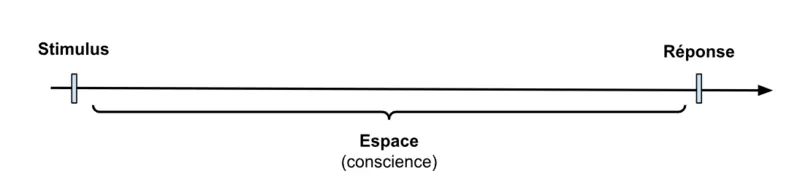
Picture the stimulus, the signal, as:
- the small thought that calls up the urge to use, or to repeat the behaviour
- or the small voice saying "what's the point, nothing will change"
- or the painful emotion that pushes towards using, or towards the compulsive act
Awareness is that space, the place from which you watch the stimulus and your own reaction closely, with your full attention and your whole felt sense.
The response is what you actually do about that stimulus.
The less awareness there is, the tighter the space between stimulus and response. That is what we call a reflex, a reaction: no conscious choice at all between the trigger and the behaviour that follows.
So the more awareness there is, the wider that space stretches.
And the wider it stretches, the more room there is for choice.
By practising watching regularly — watching what happens inside you in particular: your state, your emotions, your reactions, your thoughts, and everything that sets them off — you make that muscle of awareness more supple, and you strengthen your capacity to choose which behaviour to adopt.
So picture taking two minutes to go consciously, with that inward eye, over the whole mechanism of this invisible wolf trap.
Maybe there is a catch the hunter uses to collect his prey? If the trap grips this hard, there must be a spring somewhere, or several? How is it fixed to the ground?
That is the stance I warmly recommend when an addiction is involved.
(And yes, at some point you may be short of a tool or of the distance needed to find the spring or the catch. That is where outside help usually makes sense.)
A first assessment
Tired of going it alone?
A 45-minute conversation, free and with no commitment.
- 01Understand the mechanics behind your addiction
- 02Identify what stands between you and the way out
- 03Decide together whether this support fits you