
Blog
How to respond to an addiction? The image of the wolf trap
The metaphor comes from Thomas d'Ansembourg — once a lawyer, now an author and psychotherapist, and a former student of Marshall Rosenberg.

This metaphor comes from Thomas d'Ansembourg — once a lawyer, now an author and psychotherapist, and a former student of Marshall Rosenberg, who created nonviolent communication. He is a remarkable speaker, and his talks, which I strongly recommend, read like tales about making peace with yourself, with your emotions and with the people around you.
In a talk about fear he uses wolf traps to describe the habits we get caught in, the ones that make us and the people close to us unhappy. I am particularly fond of that image for addiction too.
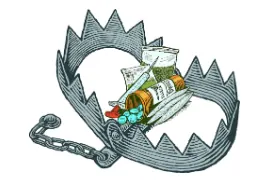
Picture yourself for a moment, caught in a wolf trap. What would you do?
I can see at least four possible answers.
1) Do nothing and wait for the trap to open by itself. Probably not much use, and hardly the safest option given there are likely wolves about — but it is still a possible reaction. If you take the addiction to be the trap and the negative consequences to be the wolves, it is very likely that some people are in exactly that position. No judgement here, mind: there are plenty of valid reasons to do nothing for a while — too tired, no time, not enough money or patience.
2) Call for help. Who knows, with any luck whoever set the trap is somewhere nearby. Or a handy sort with a cottage not far off, full of tools that could get you out of this mess. Worth a try, no? Though perhaps, at first, you would rather see whether you can manage on your own.
3) Fight it with everything you have, at serious risk of injuring yourself against those sharpened teeth. That is what I would liken to stopping by willpower, which can be a fine idea if you feel strong and agile. But sometimes — often — the outcome is unhappy: not only are you still stuck, your injuries are worse. With addiction those injuries can be many: discouragement, fear of failing, shame, frustration.
4) And the last one — I kept the best for the end, naturally — study the mechanism gripping your leg, closely. Whether you do it alone or with help, that is almost certainly the response with the best odds of getting you free.
That observer mode is also what you could call awareness: perceiving what is happening here and now, inside you and around you.
It is no accident that mindfulness meditation is so often recommended for getting free of addiction. And I can tell you without much suspense that it was one of the main tools that carried me through my own recovery.
A first assessment
Tired of going it alone?
A 45-minute conversation, free and with no commitment.

- 01Understand the mechanics behind your addiction
- 02Identify what stands between you and the way out
- 03Decide together whether this support fits you