

Understanding addiction
Toxic relationships: why we stay (and a few keys to leaving)
You know the relationship is toxic and that it hurts, yet you stay. Understand emotional dependency and how to break free at your own pace, online or in Caen.
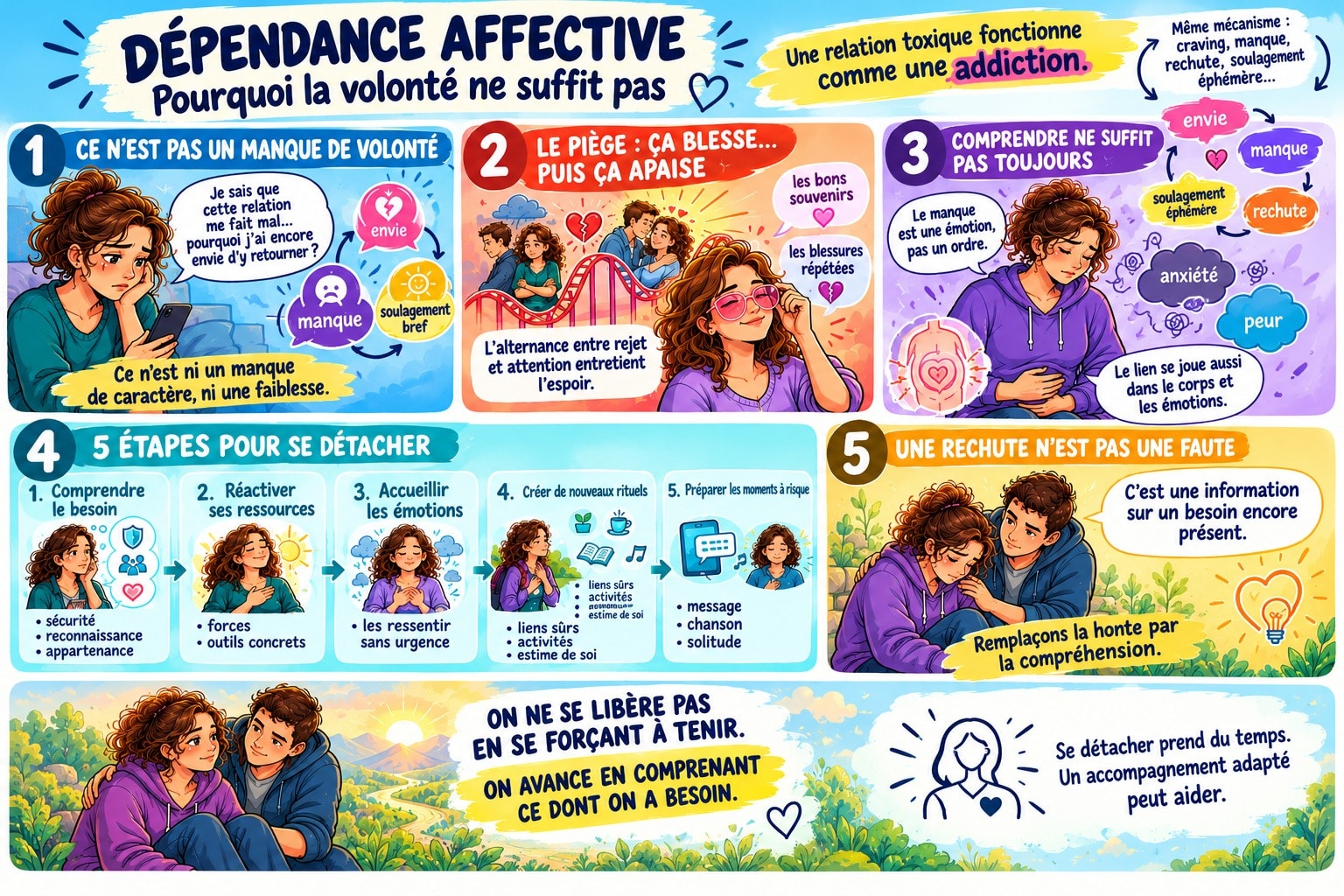
Deep down, you know this relationship is wearing you down. Perhaps you have already left, then gone back, despite the promises you made to yourself. This is not a lack of character, nor a weakness. What you are going through resembles, in many ways, what people dependent on a substance go through: the urge that keeps coming back, the short-lived relief, then the guilt and the pain that follow.
This article explains how this emotional dependency works, why willpower alone is rarely enough to get out of it, and how you can detach gently, step by step.
Key takeaways
- A toxic relationship can work like an emotional addiction: craving, withdrawal, relapse. It is not a question of willpower.
- Being under someone's hold is how we describe the inner force that keeps us close to the other person despite all the harmful sides, much like the craving that comes with an addiction.
- Stopping is not necessarily healing: as long as the need hidden behind the bond is not understood, it looks for another way out.
- A relapse is not a failing: it is information about what is still left to understand.
- Attachment also plays out in the body and the emotions: understanding it intellectually is not always enough to loosen the bond.
- Detaching is a process that takes time: it comes through understanding your needs, more than through judgement or force.
Why willpower isn't enough to leave a toxic relationship
If your previous attempts did not hold, that is not a failure. You may have been using tools that speak to the head, when the bond also lives in the body and the emotions.
A relationship that soothes as much as it hurts
The toxic partner is not only a source of pain. They are also, often, the only known answer to a need for security, recognition or belonging, frequently alongside a wish to save the relationship.
Swinging between intense attention and rejection creates intermittent reinforcement: you keep hoping for the "good times" to come back, and this mechanism is known to keep attachment very strong.
Hence the knot in your stomach, the tightening in your chest, as soon as you think about separating. Your body is not being difficult: it is trying to get back to what soothed it for a long time.
Rose-tinted glasses: when hope becomes a trap
In a toxic relationship, we often hold on to the person's good sides: the early days, the tender moments, who they could become. These memories are real, and they matter. But they can also act like rose-tinted glasses: they light up what is going well and leave everything else in the shadows, the repeated hurts, the broken promises, the reasons to leave. It is a form of denial, and it is nobody's fault: it protects us from a reality that is sometimes too painful to face.
The shadow side of hope.
We tend to think of hope as a positive emotion, and it often is: it helps us get through hard times. But it also has a darker side. When we cling to crumbs of kindness (a thoughtful gesture, an "it's going to change") while knowing deep down that the relationship mostly brings pain, hope no longer carries us towards a better future: it holds us in a situation that is hurting us. Each crumb feeds the wait for the next one, which ties in with the intermittent reinforcement mentioned above.
That does not mean you should distrust all hope. It is more about not trusting it blindly, and asking yourself: is this hope based on what is actually happening, or on what I would like to see happen? There is no ready-made answer, but the question already helps you look at the relationship as a whole.
The guilt trap
You are angry with yourself for still wanting to answer that message, when you have already analysed everything, understood everything, sometimes said everything in therapy. That shame, paradoxically, feeds the cycle: the more you judge yourself, the more the need to be soothed comes back. That is why the support offered here starts from a different place: replacing guilt with understanding.
5 steps to break free from emotional dependency
This method is the same as for other addictions (smoking, alcohol, cannabis, gambling). It combines interactive hypnosis, coaching and brief therapies, and moves at each person's own pace. Working with a therapist who specialises in addiction gives you the distance you need to understand which mechanisms keep you in this habit, despite all its toxic and painful sides.
Step 1: Decoding what the relationship does for you
First, we shift the focus from the other person to yourself: what does this relationship give me, in spite of everything? Validation, protection, a sense of existing, fear of being alone… Every urge to get back in touch holds valuable information about a need that has gone unanswered, often since long before this person came along.
Telling apart the desire to be with this person and the need for emotional security changes everything: you stop looking in someone else for what can be rebuilt within yourself.
Step 2: Activating your resources
You have already come through hard times, and you have strengths that the relationship ended up hiding. We bring them back into the light, with practical tools you can use on your own, between sessions, when the urge to contact the other person becomes pressing.
Step 3: Releasing emotions
This is where interactive hypnosis comes in. It is done in dialogue, while you stay awake: nothing to do with stage hypnosis. It gives more direct access to the emotions, memories and beliefs ("I don't deserve better", "without him, without her, I'm nothing") that steer our love choices without our realising it.
The aim is not to become cold or indifferent, but to be able to feel the absence without being overwhelmed by the urgency to fill it.
Step 4: Setting up new rituals
As the toxic relationship recedes, a void appears. If it is not filled in another way, the risk of going back to the former partner (or repeating the pattern with someone else) stays high. This is the emotional withdrawal phase. So we build other sources of comfort and pleasure: everyday rituals, relationships that feel safe, activities that nourish your self-esteem regardless of how a partner sees you.
Step 5: Anticipating risks and relapses
A message, a song, a lonely evening: some moments reawaken the longing. We identify them together, prepare responses, and you learn to get through boredom, sadness or loneliness without using the relationship as an anaesthetic. A relapse is not a failing: it is information.
Support in Caen and online, anywhere in France
I see people in Caen and by video. Video sessions mean you can be supported from home, with no travel and no waiting room, and keep up the work even when you are away. For many people, it also makes it easier to talk about things that are hard to say. Find out more about online support.
Why support that specialises in addiction?
I have been supporting people with addictions since 2017, and I went through several addictions myself between the ages of 10 and 35. That experience gave rise to an approach that does not settle for just "holding on": it looks for what the habit, or the relationship, is bringing you, so that this state becomes reachable without it. The people I have worked with give me a rating of 4.9/5 across 98 Google reviews (read the reviews).
An important point
If there is violence (physical, psychological, sexual), safety comes first. In France, the 3919, the national helpline for people facing domestic and gender-based violence (free, anonymous), listens and points you towards help. In immediate danger, call the 17 (police) or the 112 (European emergency number). Therapeutic support complements medical or psychological care when the situation calls for it.
A first step: the free assessment
Not sure this applies to you? You can start with the addiction test: anonymous, 1 to 2 minutes, no email required.
And when you feel ready to talk about it: 45 minutes, free of charge, with no judgement and no commitment. You describe your situation, we see whether this kind of support could help you, and you leave with some first insight, whether or not you decide to continue. Discover the overall approach.
The rest of the work can take place online, which makes no difference to the quality of what we do together.
Frequently asked questions
How do I know if I'm in a toxic relationship?
The most common signs: put-downs or repeated criticism, swinging between intense affection and rejection, gradual isolation, constant guilt-tripping. But the best indicator is often how you feel: a constant knot in your stomach, loss of self-confidence, finding it hard to leave despite the pain. If this sounds familiar, it can help to talk it over with a professional.
Why is it so hard to leave a toxic relationship?
Because the relationship meets a real need (security, recognition, belonging), and the swing between hard moments and tender ones keeps the attachment very strong. It is not weakness: it is a human mechanism.
How can I help someone close to me who is in a toxic relationship?
It is best to avoid judging or pushing for a break-up: that often deepens shame and isolation. You can offer to listen without pressure, stay present and, when the time is right, point them towards a professional. Your role is to remain a safe connection, not to decide for them.
How do I get someone out of my head?
Thoughts going round in circles are common after a break-up or during emotional withdrawal. They do not prove the relationship was good: they often say that a need is still unmet. They settle down once that need is understood and other sources of comfort are in place. Support can help you get there more calmly.
What is interactive hypnosis?
It is hypnosis carried out in dialogue, with no loss of control, a long way from stage hypnosis. It is used to explore and soothe the emotions and beliefs that keep the bond going. Here it is combined with coaching and brief therapies. The hypnotherapist helps you find new ways of feeling the positive emotions you were looking for through the relationship.
Do I need medical follow-up at the same time?
In some situations (acute distress, severe anxiety or depression, violence), it is advisable to also see your GP or a psychologist, alongside in-depth support like this.
Is the support reimbursed?
It is not covered by the Assurance maladie, France's state health insurance, but some mutuelles (top-up health insurance schemes) reimburse part of the cost. It is worth checking with yours.
A first assessment
Tired of going it alone?
A 45-minute conversation, free and with no commitment.

- 01Understand the mechanics behind your addiction
- 02Identify what stands between you and the way out
- 03Decide together whether this support fits you