

Understanding addiction
Hypnosis for addiction: does it really work?
Does hypnosis really work for addiction? Why suggestion alone often falls short, and how working on the emotional needs behind the habit helps change last.
We have all heard the promise: one session, a few well-placed suggestions, and the addiction vanishes as if by magic. Yet alone with a craving on a Tuesday evening, or faced with a glass at a work dinner, reality rarely looks like what we were sold.
Wondering whether hypnosis really works for addiction is a fair question. Especially when you have already worn out your willpower, tried patches, support groups or other therapies, and nothing has lasted. And if nothing has held so far, that is not a personal failure.
My aim is not to judge the tool: every method has its place, and can be valuable. It is rather to understand why hypnosis disappoints when it is used like a magic wand, and what it makes possible when it becomes one lever within a broader piece of work.
Key takeaways
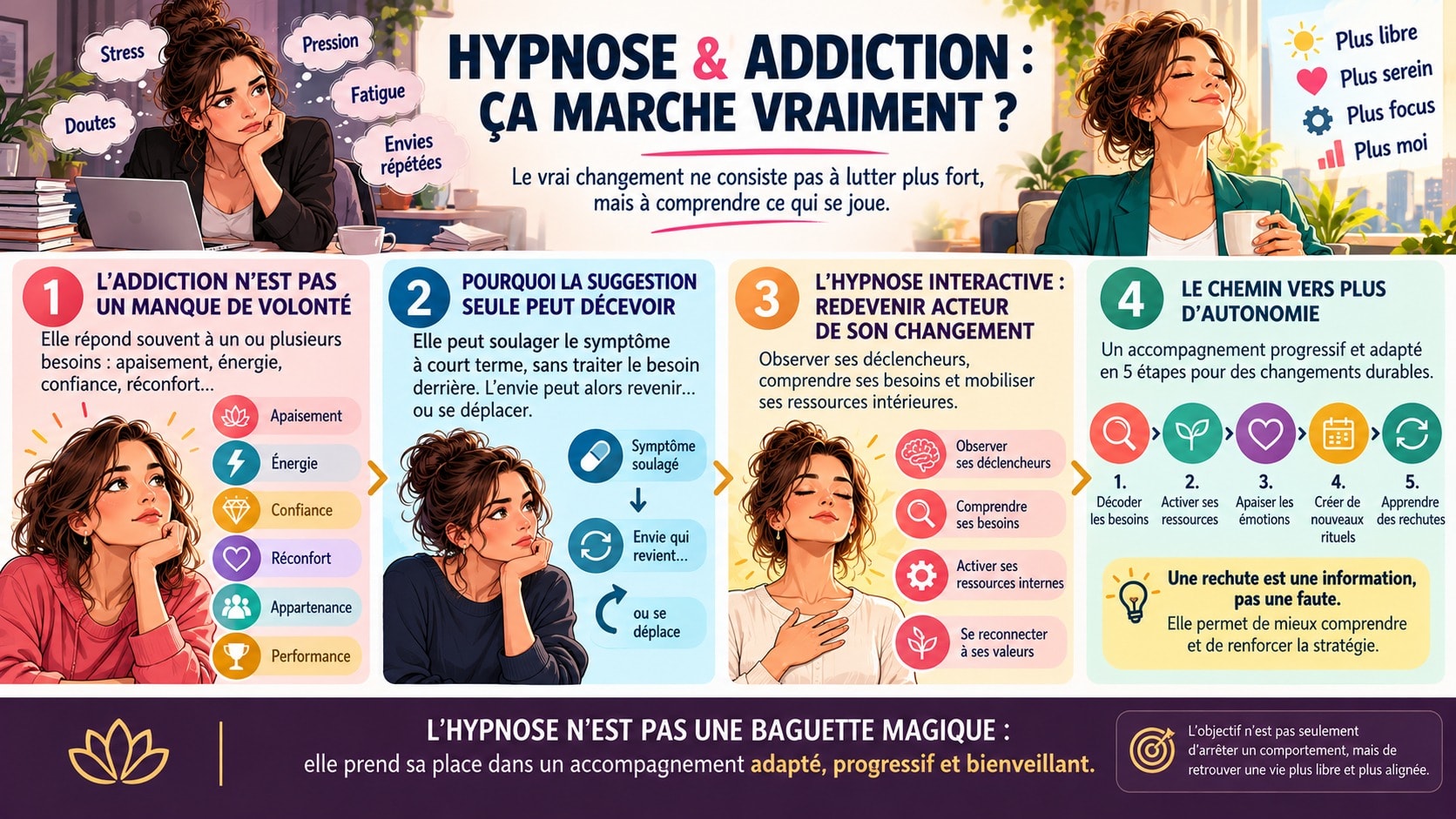
- An addiction is never there for no reason: it is an attempt to answer a need, a pain or a lack. As long as that need goes unheard, it looks for another way out.
- Purely suggestive hypnosis works on the symptom. It can bring relief for a while, but often leaves the need untouched, with the risk that the addiction simply moves somewhere else.
- Interactive hypnosis keeps us active and aware: it helps us find, from within, the states the addiction was trying to give us.
- A relapse is not a failing, it is information: it shows where a need is still waiting for an answer.
- The five-step method I offer takes place over time (3 to 12 weeks on average) and aims for real autonomy: gradually becoming your own therapist.
Addiction as a messenger rather than an enemy
An addiction is neither a flaw nor a lack of willpower. Set the guilt aside and it is first of all a habit that is hard to change, with mostly negative consequences for you and the people around you. And that habit does a job: easing tension, quietening the mind, feeling less alone, dealing with boredom, getting back some energy or confidence, staying creative, rewarding yourself…
Gabor Maté, a physician and leading author on trauma and addiction, describes it as an attempt to solve a problem: the problem of emotional pain, stress or loss of connection.
Having been through many addictions myself between the ages of 10 and 35, I know how much this change of perspective matters: you stop fighting yourself and start listening to what the addiction is trying to tell you.
Why "classic" hypnosis often disappoints when used on its own
Many protocols still rely on suggestion: you receive positive phrases in an altered state of consciousness, in the hope of "reprogramming" the brain without touching what really drives the behaviour. This can bring genuine relief in the moment. But that relief rarely survives the return of the stress, tiredness or emotions that were feeding the addiction in the first place.
The myth of the magic suggestion
Believing that a sentence heard in trance will wipe out years of habit means forgetting that addiction is tied to very real needs. Change is then imposed from the outside, instead of building on our own resources. And we may simply shift the dependence: onto the session, onto the practitioner… or onto another habit.
Someone who stops smoking through suggestion alone may become irritable, or start snacking, because the need for calm, for a break or for a reward that the cigarette used to meet has not found another answer. That is why it matters so much to treat the cause rather than the symptom.
The myth of willpower
When the effect of the session fades, the old strategies take their place again. They were answering a need, even if they were hurting us. You can know perfectly well that "it's bad for you": the body and the emotions keep asking for what has soothed them for years.
And that is normal. The unconscious is far stronger than willpower: it is what regulates our heartbeat, our breathing and our temperature, without us having to decide anything. Willpower, on the other hand, is a limited resource, often already stretched by everyday life. Relying on it alone is a bit like struggling in a wolf trap: exhausting, guilt-inducing, and the jaws tend to close tighter.
It is also this mechanism that so often leads us to hand over the power to feel good to a substance or an outside ritual.
What interactive hypnosis changes
Interactive hypnosis sits somewhere between guided daydreaming, NLP, sophrology and mindfulness. Unlike Ericksonian hypnosis, which is more passive, you stay active and aware: we talk throughout the session, and the images come from your own memories and imagination. It has nothing to do with stage hypnosis: we work in dialogue.
Observing rather than struggling
Rather than fighting the symptom, we look at the mechanism with curiosity and without judgement: when the craving arrives, what comes before it, what it promises. Viktor Frankl, the psychiatrist who founded logotherapy, reminded us that there is always a space between the signal and our reaction. The narrower that space, the more we act on reflex. By developing our awareness, we widen it, and that is where the freedom to choose a different response lies.
Identifying what the addiction does for you
Every addiction is trying to bring us something: physical release, a calmer mind, energy, confidence, a creative spark, a kind of company… As long as that function is not understood and respected, stopping can feel like deprivation, even like losing a part of yourself. Resistance sets in, or the addiction moves: quitting smoking turns into snacking, abstinence gives way to constant irritability.
Finding those states for yourself
This is the heart of the work: learning to find from within what the addiction used to give you, and discovering that those states never belonged to the substance. It takes time and a caring setting, where you can experiment without pressure to perform, and without forgetting pleasure.
The limits of hypnosis, in all honesty
Hypnosis is not a universal solution. Acknowledging this lets everyone find the approach that really suits them.
Without a solid relationship of trust, or if the emotional work stays on the surface, sessions for smoking or alcohol often lead to fragile stops that do not survive the first hard knock. Timing matters too: in the middle of a difficult withdrawal, or before you have worked out what really makes you want to change, even a very good tool will struggle to take root.
Finally, this approach asks for commitment. If you are only looking for a quick fix, with no wish to look at what is going on behind the addiction, it may not be right for you.
Relapse: information, not a failing
A relapse is not a moral failure. It is a sign that a need has not yet found its answer in your new way of living.
Replacing guilt with understanding
Rather than sinking into shame, you learn to look at the relapse with curiosity: what event, what emotion, what context came before it? This attitude defuses the vicious circle in which guilt itself becomes a trigger. The slip becomes a step in learning, not a verdict on your worth.
Refining the work on triggers
Each relapse sheds light on a trigger that had not yet been given enough attention: an unnamed loneliness, a deep tiredness, an old conflict. We then adjust the strategies and strengthen resources where they are still lacking. It is this process, repeated patiently, that builds a solid freedom, far from promises of instant cures.
A five-step method, at your own pace
In the support I offer, in Caen or online anywhere in France, interactive hypnosis is combined with needs-focused coaching, cognitive behavioural therapy, NLP, mindfulness and nonviolent communication. The framework stays the same; the tools I draw on most vary with the addiction and the needs it hides.
- Decoding the functions: identifying the needs the addiction is trying to meet, and what stops you from reaching the states you are looking for naturally.
- Activating resources: learning, through interactive hypnosis, to find those states from within.
- Releasing emotions: welcoming and soothing the emotions that were feeding the addiction.
- New rituals: building tailor-made habits that really meet your needs, and learning to express those needs and your limits to the people around you.
- Risks and relapses: spotting risky situations and thoughts, and turning every slip into useful information.
Sessions last 1 hour 30 minutes, closer together at first and then further apart, over three to twelve weeks on average. Discover the method and its tools in detail.
In our own cockpit, we remain the only ones in command. My role is that of a co-pilot: helping you read your own instruments (emotions, thoughts, needs, behaviours, intuition) to regain a lasting freedom, built on meaning, fulfilment and autonomy.
The people I work with often describe a gradual shift: the addiction loses its grip, not through force, but because it slowly becomes less necessary. As one Google review puts it: "A different approach to hypnosis. I wasn't convinced when I left, but since then I've been sleeping without pills, the addiction is gone, the grief is behind me…" (Marie M.)
How do you know if it's the right time?
Not every addiction calls for the same kind of support. But if you have already tried several approaches without lasting results, it may be a sign that it is time to explore what is going on underneath, rather than continuing to treat the surface.
The most telling sign is not how serious the behaviour objectively is, but the growing gap between the person you want to be and what you keep doing, despite your best intentions. Even if you are still "functioning" very well socially and at work.
To see things more clearly, you can start by understanding your own addictive mechanisms, take the online addiction test (anonymous, 1 to 2 minutes), or book a free 45-minute assessment, with no commitment, to take stock of your situation.
Frequently asked questions
How many sessions does it take to get lasting results?
It depends on the person, the addiction and how long the mechanisms involved have been in place. On average, the support runs over three to twelve weeks, with 1 hour 30 minute sessions. Unlike a single session, this framework leaves time to understand the needs in depth and build solid resources, before consolidating your autonomy.
Does interactive hypnosis work just as well online?
Yes. Many people are supported remotely, all over France, and video is no obstacle to in-depth work, as long as the connection is stable and the space is quiet and private. Some even appreciate feeling safe in their own surroundings when talking about intimate subjects.
I've already tried hypnosis and it didn't work. What now?
A disappointing first try often comes from an approach that was too suggestive and did not take into account the emotional needs behind the addiction. Rather than giving up on the tool, it can help to explore an interactive approach, one that works in dialogue with you rather than imposing change on you, within a structured programme of support.
Do I need medical follow-up at the same time?
For some withdrawals, alcohol in particular, or in cases of acute distress, it is advisable to see your GP for a medical check-up. If your use is putting your health in immediate danger, medical care comes first. Interactive hypnosis support then comes alongside or afterwards, to work on the emotional causes and help prevent relapse.
A first assessment
Tired of going it alone?
A 45-minute conversation, free and with no commitment.

- 01Understand the mechanics behind your addiction
- 02Identify what stands between you and the way out
- 03Decide together whether this support fits you