
Understanding addiction
Leaving addiction as a political act
A little-known story sheds a lot of light on our relationship with consumption, and so with addiction. It starts with one man: Edward Bernays.
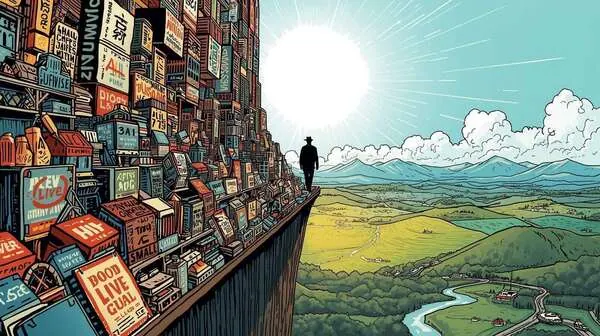
A little-known story sheds a great deal of light on our relationship with consumption, and therefore with addiction. It starts with one man: Edward Bernays.
In the early 1920s, while his uncle Freud was publishing his work on the death drive (1920), Bernays developed an obsession: the violence of crowds. He was convinced that if humans were left to themselves, their natural aggression would eventually destroy everything. So he came up with a solution of formidable efficiency — one that is chilling to look at today.
To stop the beast inside from waking, it had to be kept busy. It had to be fed. Drawing on his uncle's work on the unconscious, he engineered a historic switch: turning the citizen into a consumer.
His stroke of genius was to replace the logic of "I need" (my coat has holes in it, I will buy another) with the logic of "I want" (this coat will make me look important). By tying ordinary products to our deepest aspirations — freedom, power, belonging — Bernays did not merely invent modern marketing.
He also designed the machinery of consumption as a vast social anaesthetic. He taught us to settle our anxieties and our inner violence by reaching for a card, and built a world where buying and consuming became the main emotional buffers for channelling our impulses.
Picture the context: the middle of the interwar years, with social, economic and diplomatic tensions running very high. It is hard to condemn the man for trying to create calm through consumption.
But you can also see the conditioning that produced all the wrong turns of our current society, over-consumption first among them, at the expense of our health and of the planet's.
Working to get past your addiction, whatever it is, is therefore not simply an effort in your own interest. It is a political act that shows, by example, how to step out of consumer society towards something more balanced and less harmful — for ourselves first, but also for our species and for the earth we live on. By taking better care of yourself, you gradually set out towards taking better care of others.
You may know the image of the hummingbird who, faced with a vast forest fire, keeps flying back and forth to fill its beak with lake water and pour it on the flames. When the other animals ask, with some amusement, what it expects to achieve with that tiny beak, it answers: "I am doing my part."
A first assessment
Tired of going it alone?
A 45-minute conversation, free and with no commitment.

- 01Understand the mechanics behind your addiction
- 02Identify what stands between you and the way out
- 03Decide together whether this support fits you