
Other topics (health, resilience, motivation…)
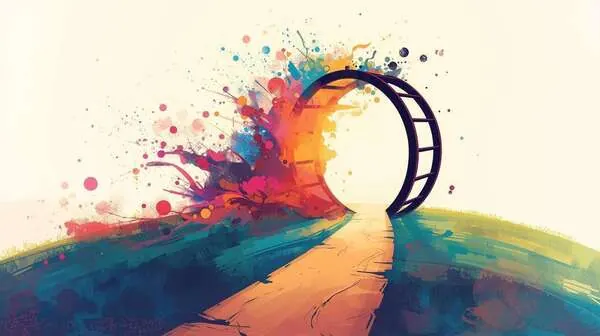
An invitation to step off the wheel
A deliberately late happy new year. I had told myself I would do everything to send this before the end of January. Then I decided convention could forfeit this one too.
A deliberately late happy new year
I had told myself I would do everything to get this out before the end of January. Then I decided convention could forfeit this one too.
If the planet and today's nervous systems are running this hot, it is probably a sign that slowing down is urgent. And that most likely starts with obligations of principle — the ones born of guilt and of fear of judgement, which in themselves are of very little interest.
There are already so many occasions in this life to be in a hurry.
In fact I see every day that one of the most effective ways to settle our own state, the people around us and our society, and to let our home planet recover, is precisely to step — as far as we can — off the wheel we run on far more often than we actually want to.
If only to take the time to reconnect with what we want and what we intend.
The sweet myth of resolutions
Here we are, at the start of the year when many of us aspire to become a "better version of ourselves".
Cheerfully and full of good intentions, we dress ourselves in new resolutions. After all, it is the moment: if the year is changing, why not us?
But much as I love the force of change, and the privilege of supporting it as a coach and therapist, I detest resolutions.
Why? First because they sound less like something you want than like something you owe. And because they rest, almost always, on a resource we routinely overestimate: willpower.
Willpower is a limited resource.
If we are lucky enough to wake with it at 100%, it is very likely that after a day full of demands, decisions and micro-frustrations it will be spent.
And the impulse that looked so attractive at the start — full of adventure, promise and novelty — quickly becomes one more constraint we have loaded onto ourselves, and one we inevitably end up dropping.
So the question is this: what are these resolutions missing, that would let them work?
From the resolution to the need
First of all, they are usually missing meaning.
There is always a good intention at the start — "I'm going to the gym to get a decent shape back" — but the enquiry stops far too early.
Setting yourself a resolution that demands a fair amount of willpower on reasons you have only half explored is a bit like holding a very large kite by the crook of your little finger: the pull is far too strong for the grip.
For it to hold, the resolution has to be tied to deep, important needs.
Take the shape example. If I get back in shape…
- I will feel comfortable in my own skin (wellbeing, self-esteem)
- I will feel easier socially (connection)
- I will want to go out and be attractive again (adventure)
- I will be able to wear clothes I actually like (aesthetics)
- I will be able to take up the physical activities I used to enjoy (pleasure)
- I will be able to play outside with my children more often (sharing)
The truer, the more numerous, the more alive and the deeper the reasons, the stronger willpower becomes. Conversely, plenty of resolutions die out quite rightly, because the motivations underneath them are too weak or too superficial.
The question of choice
I can still see myself as a teenager, in a heated and no doubt over-lubricated argument with a friend who insisted he was entirely immune to consumer society and its influence. I thought it was extraordinarily presumptuous. I still do.
Let us be honest: our will is never quite straight. It is permanently bent by the magnetic field, sometimes invisible, of everything pulling at us from outside.
Well-aimed advertising, the brands and algorithms studying us, the smell from the bakery, the friend sending live photos from the ski slopes, or the feed that never stops murmuring that life is prettier, more exciting or freer somewhere else.
We are swimming in a sea of prompts, and it is often a rough one.
The good news is that there is a way to turn that consumer leaning to our advantage: by creating choice. Our freedom does not lie in systematic discipline or forced abstinence, but in how rich our menu is for answering the needs we have identified beforehand — calm, connection, adventure, creativity, and so on.
Creating choice — a menu of activities consciously built around those needs — means taking back power over all the default choices we would otherwise have made.
It means being able to say that whatever our mood, our energy level or the conditions outside, there will always be a nourishing, fitting alternative to hand — and if there is not, we make one.
In short, you no longer start from the resolution but from what you would like to feel. And from the need you have identified, you build up, bit by bit, a range of actions or activities that answer it.
The positive feeling you are after becomes the guide, and choice becomes the spur. It is one way — certainly not the only one — of building a life that is stimulating and, above all, far less prone to frustration.
A first assessment
Tired of going it alone?
A 45-minute conversation, free and with no commitment.

- 01Understand the mechanics behind your addiction
- 02Identify what stands between you and the way out
- 03Decide together whether this support fits you